
Plant Medicine
I get letters: Processing emotions “practices”.
By Becca Williams | May 28, 2026
…
Read more
Start typing to search…
Chronic stress isn’t a willpower problem. Becca Williams, emotions therapist & plant medicine guide, covers why you can’t just relax and what helps.
Becca Williams
Emotions Therapist & Registered Dietitian
Published May 1, 2024 | Last Updated October 24, 2026
You’ve tried the breathing apps. The time-blocking. The vacation that was supposed to reset you.
And within a week of being back, it’s there again – the tight chest, the racing thoughts at 2am, the sense that you’re one more email away from losing it.
That’s not because you’re bad at managing stress. It’s because “stress” was never the actual problem.
Stress is a catch-all word – the thing we reach for when something feels awful and we can’t quite name it. When you say “I’m stressed,” what you usually mean is some cocktail of Anxious, Fearful, Frustrated, and overwhelmed, all compressed into one syllable because naming the specific emotions underneath feels like too much work in the moment. Stuck. Frazzled. Burnt out. At the end of my rope. Different words, same signal: something is off, and it feels bigger than you can handle right now.
In the Emotional Liberation® work, we start by getting specific. Stress is the ball. The emotions are what’s inside it. You can’t work with a ball. You can work with what’s inside it.
A deadline, a demanding project, a financial pressure – none of these are inherently stressful. You could be deep in something hard and feel energized by it. The stress shows up with the thoughts that ride along with the circumstance: “What if I don’t make it?” “What will they think of me?” “I should be further along than this by now.”
Those thoughts generate the feeling. Anxiousness. Self-doubt. Frustration when things won’t move fast enough. That’s the moment stress is actually born – not in the circumstance, but in the story about the circumstance. Which means you can’t address the thought without addressing the emotion underneath it, and you can’t address the emotion by only managing the thought.
In my work, Fear sits at the root of most stress responses. At its core, stress is the felt sense that something isn’t the way it should be – that there’s a gap between what is and what needs to be. The body reads that gap as a threat, whether or not it actually is one, and responds accordingly: tight shoulders, shallow breath, a nervous system that won’t stand down.
There’s a pattern worth noticing. Under chronic stress, the problem starts to feel bigger than you are. Your thoughts spiral around it, your body contracts, and the whole situation takes on a weight that says: not “I can handle this,” but “I’m not sure I can.”
In the Emotional Liberation work, we address the Fear directly through Psycho-Spiritual Inquiry and your deep inner knowing – and we do it from a grounded place, not a depleted one. When you shrink under stress, your body follows the shrinking. The antidote is the opposite: occupying your body fully, shoulders back, chest open, breathing with intention, speaking to yourself with some measure of confidence instead of dread. These physical, mental, and emotional shifts rebalance the felt relationship between you and the problem – and that’s what lets the emotions underneath finally be felt, processed, and released, instead of just managed.
Chronic stress isn’t a willpower failure or a scheduling problem. It’s what happens when your life force – what yogic traditions call prana – is being spent faster than it’s replenished. Every thought, every emotion, every interaction either feeds you or drains you. Unresolved emotions are where most people lose the most energy without realizing it: worry, unresolved Anger, negative self-talk, Fear that’s never been met. These aren’t just uncomfortable. They’re expensive. They pull on your reserves around the clock, even when you’re not consciously thinking about them.
That’s where Emotional Liberation is different from standard stress management. We’re not trying to think our way to calm or meditate past what’s actually unresolved. We’re helping you locate what’s draining you, feel it fully, and let it move – so the nervous system stops running the old alarm long after the original trigger is gone.
In practice: I help you read what your stress is actually signaling. Then we experientially work with Psycho-Spiritual Inquiry, expressive movement, and specific breath support – stirring up the emotions tethered to stress that have been stored in your tissues and nervous system. Some call this composting: bringing the old material to the surface, processing it consciously, and letting it break down into something usable instead of something that keeps leaking out sideways. The body is wise. It knows how to recover when it’s given the right conditions.
There’s something important here that often gets missed in the conversation about stress.
If you have real stressors – financial pressure, a relationship that isn’t working, a job that’s grinding you down – you cannot meditate your way to peace while those things remain unresolved. Acceptance practices are powerful, but acceptance doesn’t mean tolerating what actually needs to change.
At the same time, you can work with what’s available to you right now: the emotions that have been building and pounding loudest on your head. Once you’re in touch with what you’re actually feeling, you have the clarity to act on the practical situation – the conversation that needs to happen, the boundary that needs to be set, the decision you’ve been avoiding. The emotional work and the practical action aren’t separate tracks. One makes the other possible.
The science is catching up with what the ancient traditions intuited about depletion. Chronic stress is associated with dysregulation of the body’s stress response system, immune impairment, and what researchers call allostatic load – the accumulated wear and tear of sustained stress on the body and brain. A 2025 integrative scoping review traced exactly this pathway from chronic, unresolved stress through to clinical burnout, and a parallel body of research links trauma and chronic stress to lasting changes in amygdala and hippocampal function – the circuitry responsible for threat detection and emotional regulation.[1,2,3]
The nervous system research backs up what movement-based healing has claimed for decades. A systematic review of neurobiological studies on mindfulness and meditation found measurable brain changes – increased cortical thickness, reduced amygdala reactivity, improved connectivity – linked directly to better emotional regulation and stress resilience. Separately, a large meta-analysis of 61 randomized controlled trials covering nearly 6,000 participants found that mind-body exercise significantly reduced anxiety, with sessions over 60 minutes showing the strongest effects – one more data point for why we don’t stop at talking about the stress, we move it.[4,5]
“Stress is the word we use when we don’t know what we’re feeling. Once we’re able to uncover the emotions fueling it, the path forward becomes clear – and we can begin to reclaim our lives from it.”
– Becca Williams
This isn’t simple, and I won’t pretend it is.
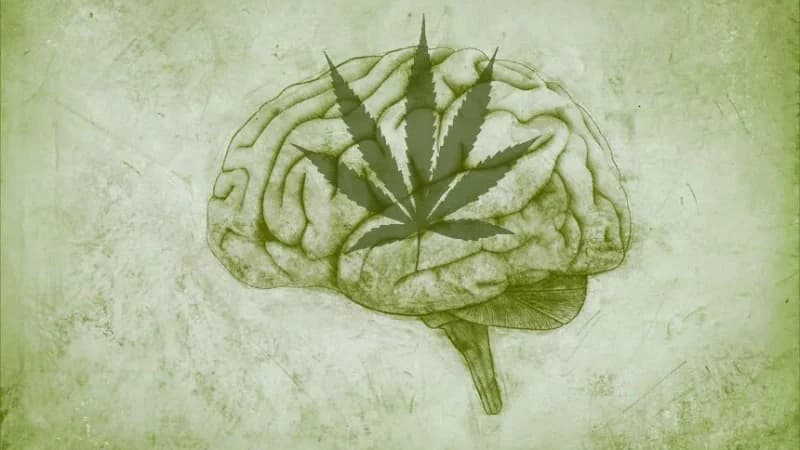
Cannabis can relieve stress – or amplify it considerably. It depends on the strain, the dose, the context, and what’s already happening inside the person using it. High-THC cannabis taken without intention, in a body already running hot from chronic stress, often intensifies the spiral rather than interrupting it. Low-dose cannabis in a ceremonial container, with clear emotional intention and a skilled facilitator, is a different experience entirely – one that can open access to material that’s been defended against for years, with the endocannabinoid system itself acting as a key regulator of the fear and stress response.[6]
Psilocybin works differently, and there’s a growing body of research specific to chronically stressed nervous systems. One preclinical study found that psilocybin enhanced fear extinction – the brain’s capacity to unlearn conditioned fear responses – across stress-naive, acutely stressed, and chronically stressed conditions alike, suggesting it may help a nervous system that’s been running the alarm for years finally learn that the alarm can go quiet.[7] For some people, this kind of access is exactly what talk-based approaches to stress have not been able to reach.
Neither medicine is a shortcut. Both require preparation, a skilled container, and real integration afterward – otherwise what surfaces just gets re-buried. And both remain, always, optional. My group masterclasses, retreats, and ceremonial gatherings bring people into this work together, and there’s a particular alchemy to doing it in community. Chronic stress is often deeply isolating. Doing this work alongside others who are in it too is its own form of relief.
Whether the starting point is Psycho-Spiritual Inquiry, movement, breathwork, or plant medicine – what makes change from chronic stress actually last is what happens after the session ends.
Understanding why you’ve been running on empty, saying yes when you mean no, or treating exhaustion as a personality trait – that’s the breakthrough. But insight alone doesn’t rebuild a depleted nervous system, and it doesn’t renegotiate the job, the relationship, or the schedule that’s been draining you in the first place.
It doesn’t tell you what to say when your manager piles on another deadline the week after you finally set a boundary. It doesn’t show you how to protect the recovery time you just carved out when everyone around you still expects the old, always-available version of you to show back up. It doesn’t prepare you for how strange it feels to have energy again, in a life that was built around you not having any.
This is what we call the shaken snowglobe. You’re changing on the inside – your nervous system is finally settling, your reserves are finally refilling – but the outside hasn’t caught up yet. That gap, between who you’re becoming and a world still calibrated to the depleted version of you, can feel destabilizing. Sometimes lonely. Sometimes it looks like old stress flaring right back up, which can feel discouraging, like none of the work took. It did. The snowglobe is still settling.
This is where most stress-management advice stops – at the breathing exercise, the retreat, the insight. We don’t stop there.
Once the emotional root starts to shift, we work on what that actually looks like in your real life. How to say no without the guilt spiral that undoes it an hour later. How to protect your energy in relationships and jobs that were built on you not having any left to protect. How to tell the difference between a stressor you need to sit with and process, and one you need to actually walk away from.
The inner work and the outer work. Together. That’s what makes it last – and that’s where a complimentary Discovery Session, or one of the group gatherings, usually begins.
Sessions work with the nervous system root. A retreat offers deeper immersive reset.

To feel your emotions instead of suppressing them, name what you feel, stay with it a little longer, check whether it’s discomfort or danger, and come back. Each step comes with an honest note on what the research does and doesn’t show.
Sitting still doesn’t work for everyone. In a 2025 survey of 886 US adults, 31.4% reported a challenging, difficult or distressing meditation experience (Van Dam et al., Clinical Psychological Science). This guide offers five gentler ways to practice calm, with an honest evidence label on each one and clear cues for when to stop.

Feeling stressed is common: Gallup’s State of the Global Workplace 2026 report found 40% of employees worldwide felt a lot of stress the previous day in 2025. This guide offers five gentle steps, naming, moving, orienting, a slow exhale, and one small task, with an honest evidence label for each, plus when to seek help.